July 29, 2025
I do see many commenting on the specifics of the deal but what matters here is the big picture. Nobody wants trade wars but the EU was far too quick in acceding to US’ demands. As many (see, e.g., Alan Beattie), have highlighted this does not bode well. This is not – obviously – the end. The US will soon have new requests and air new threats. What will the EU do then? Quickly sit again at the table?
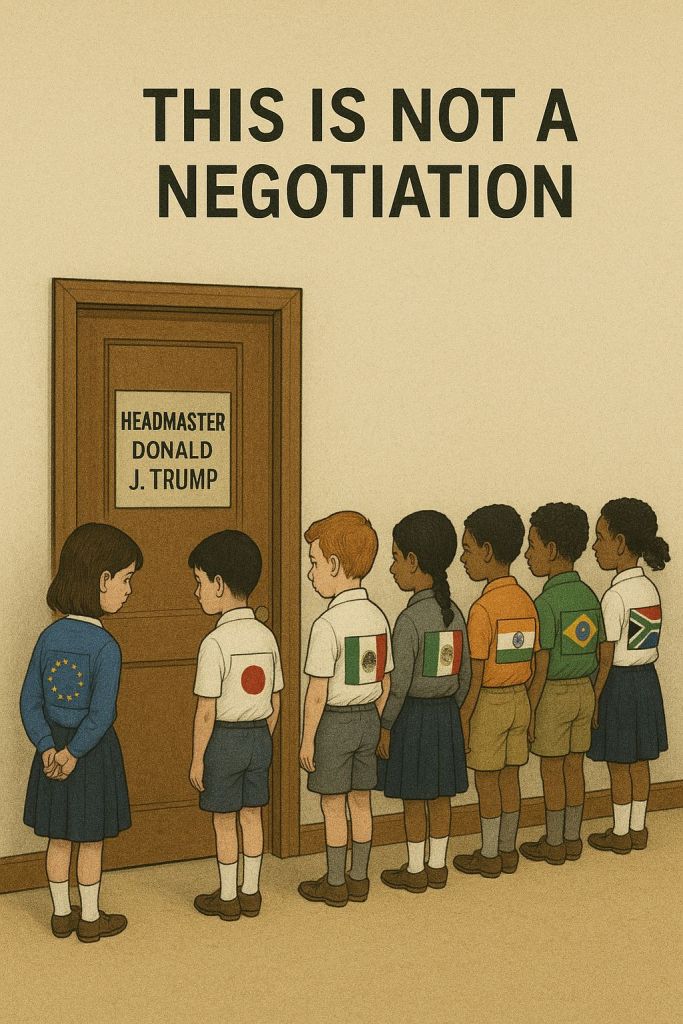
Thinking about all these US – X, Y, Z deals – it obviously takes time to psychologically adjust to this new type of diplomacy where rule-based, – oriented etc systems are out of the window and power reigns. Honestly, can we really say that these deals come out from genuine negotiations?
That being said, I cannot but think that statements coming from the EU & the like are completely void. “We have avoided a trade war”, “it is a good deal”, etc … Well, we are already in a trade war scenario! The only, very strong word, that comes to my mind when thinking about how quick “allies” are in accepting to sit at the table and digest virtually every request coming from the US is “appeasement”. Another reminder of the 1930s. What a nasty period we are living in.
The problem is that the message coming from many quarters is that far too many are not really getting the deep nature and sheer magnitude of the problem. Just reading one of the main headlines of the Italian (at least in name) broadsheet Corriere della Sera “L’ANALISI: Dazi, dalla Polonia alla Francia: chi vince e chi perde dopo l’accordo tra Usa e Ue” (translation: “Analysis: tariffs, from Poland to France: who wins and who loses after the US-EU deal”. Once again, this is completely out of focus, everybody is losing!
But there is more than this (and I am putting my lawyer’s cap now).
Perhaps, this – and other – deal(s) the US has struck, and is striking, are not legal:
1) I very much doubt that a “bilateral” deal can trump (sic!) a WTO promise (which is “multilateral”),
2) perhaps this is one of the classic textbook (almost James-Bond-like) cases where the treaty (a deal is nothing else than a treaty under PIL) is void because it is the result of duress. See Article 52: “A treaty is void if its conclusion has been procured by the threat or use of force in violation of the principles of international law embodied in the Charter of the United Nations.”
Well, of course, these days PIL does not have much currency but still …
Post-publication note (July 30):
The Smiths’ song (Cemetery Gates, 1986) goes
“‘Cause there’s always someone, somewhere
With a big nose, who knows
And who trips you up and laughs when you fall
Who’ll trip you up and laugh when you fall”
A good friend of mine reminded my that the consistent interpretation of Article 52 VCLT only applies to the limited circumstances of threat or use of military force (see, e .g., Klabbers, international Law, 2024, p.63). Economic or political pressure would not do the trick. This was debated in the negotiations of the VCLT and eventually excluded with the inclusion of a Declaration that simply condemned economic and political coercion with apparently no legal consequences. I am perfectly aware of this. But – this is the ethos of my comment – in a world where everything is in flux (including international law) nobody knows what a repentant signatory would or could raise as defence to a deal concluded under severe pressure. And, in an increasingly geopolitical world, countries seem to be particularly sensitive to pressure from the outside and adopt unilateral or autonomous tools to tackle it (perhaps the best example in town is the EU Anti-Coercion Instrument).
Post-publication picture (July 30):
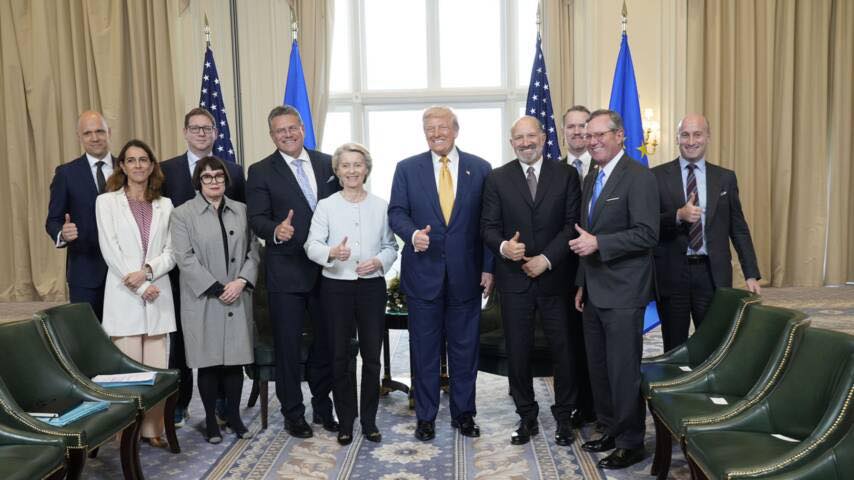
In a Saloon world, do you want a (fun) evidence of coercion? Not all thumbs are up!
Post-post-publication clarifications (August 26)
First. Ms Sabine Weyand has made it clear why she did not raise her thumb up. …
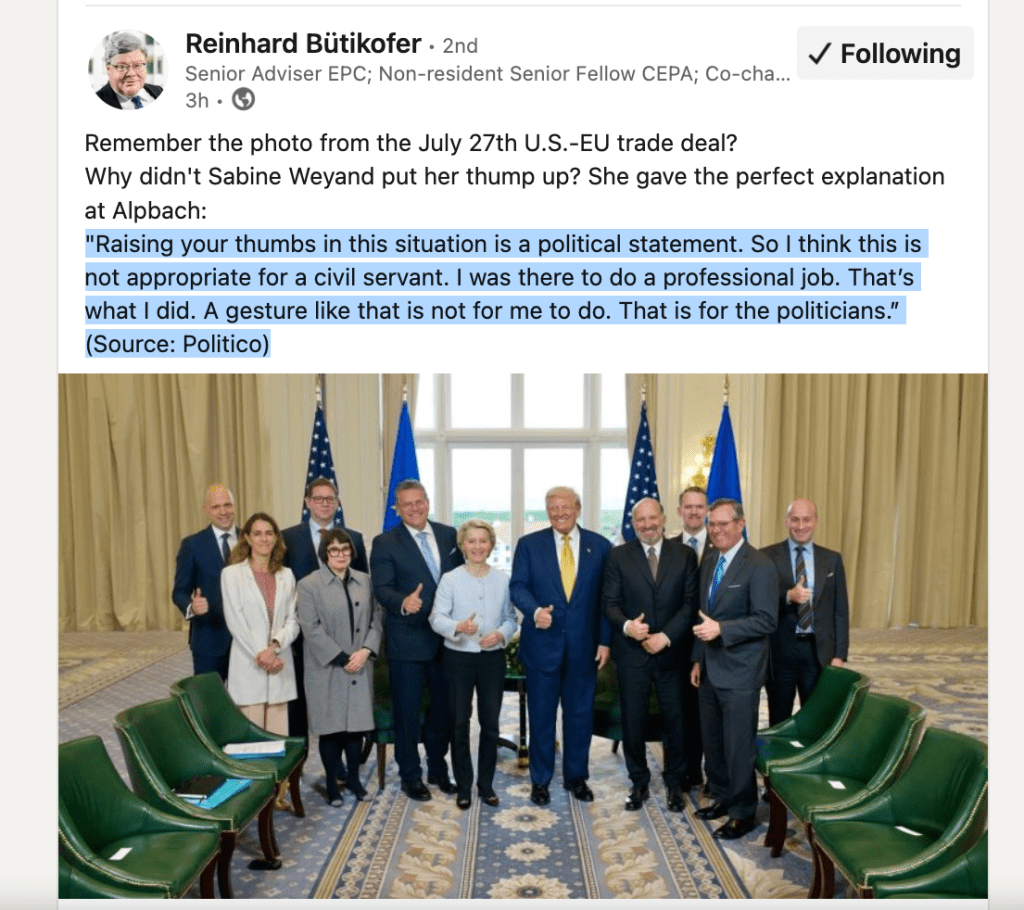
Second. Trying to contextualise the deal, and drawing on an article in Politico published yesterday, Marco Bronckers wrote a short-and-sweet article on LinkedIn.
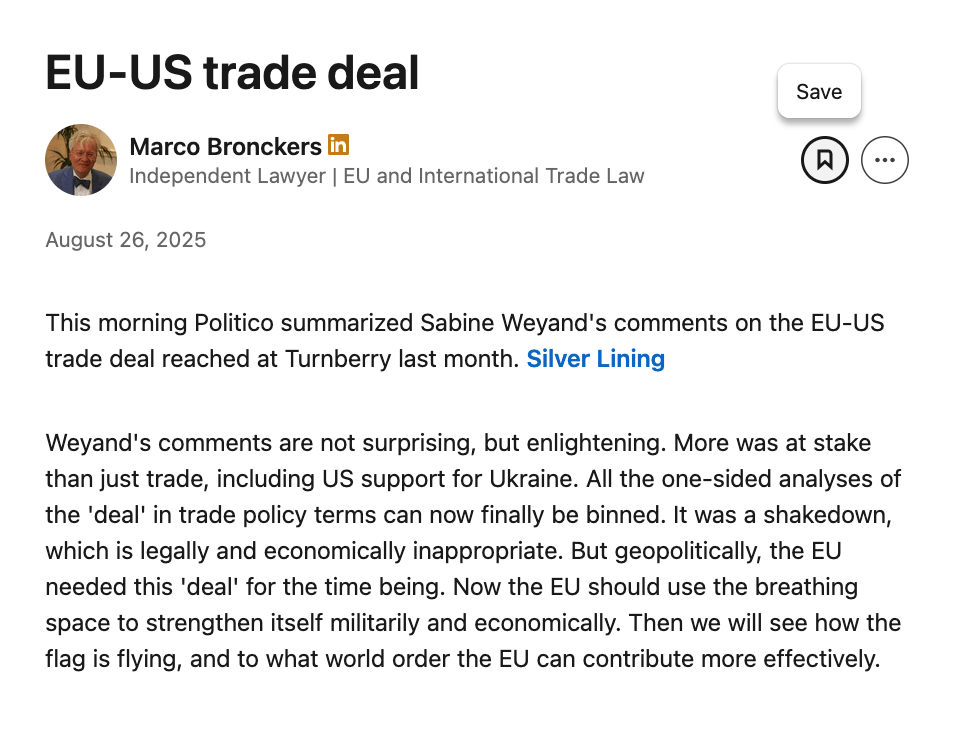
The crux is that the EU is facing multiple crisis and a deal that economically may sound sub-optimal may in fact be positive if set against the multi-faceted context. Fair enough.
We have now to wait and see how the gentlemen agreement (this is what the August 21 “framework agreement” looks like) shapes out – and who’s the winner going to be, eventually. Many (including myself) have been shouting with outrage but, perhaps, with a bit of hindsight, a more comprehensive assessment is needed and – as said – this cannot but be preliminary only at the moment.
The beast may have been tamed, for now.
(PS: this is an allegory; I am not saying anyone or anything is a “beast”: don’t take it literally please!).
Juggling different objectives
The EU is facing a very difficult future now. On the one hand, it remains the leader in defending multilateralism (which is not dead – yet). This is the medium-to-long-term objective. On the other hand, it has to address the immediate crises which are troubling it – from the economy to war and security. This is obviously short-term.
Legally, the framework agreement is an interesting animal.
It is a “framework” deal which puts out immediate commitments (or something short of them … as noted, it is a gentlemen’s agreement in nature) as well as the objectives for the negotiations that are about to come.
On its face, it genuinely looks like the first step of a process. Towards what? Towards what we have been calling PTAs or FTAs. In our case, a resurrection of the TTIP for contemporary times.
If that is the case, the EU may be able to square the circle and ensure the respect of the cornerstone of the world trading system, i.e. non-discrimination in the form of MFN.
GATT Article XXIV – for what this now matters – may also be saved. But, as repeatedly said, we have to wait and see. From the EU perspective, the agreement is truly a diplomatic feat.
Changing my mind?
The reader should not be surprised that this blog post started by saying the deal was inherently bad (end of July) and it now concludes by praising it (end of August).
Like many things, thinking has to mature and may well change!
The uneasiness with the deal remains, the very negative view for the hegemon forcing others to sit down and negotiate with the threat of a stick remains. So does the view for provincial and one-sided domestic readings.
With time, however, and considering all overlapping crises facing Europe and the world, my broader view has changed and has become more nuanced.
 lucaslaws